


By Scott M. Fulton, III, Betanews
One of the stated goals of the European Commission over the past few years has been the fostering of a healthy and vital creative community, a kind of second or third Renaissance brought about by the rapid growth of digital media. But the key fuel for growing the content community as rapidly as the technology community will be the same fuel that tech requires: money. And online content creators aren't getting much of it, a continent-wide EU survey concludes this week, because a sizable plurality, if not a majority, of consumers there believe they're already paying for "free" content -- some too much so.
According to data compiled from member nations by the European Union's statistics and record-keeping agency Eurostat, which sampled survey responses from 211,651 individuals in 148,604 households, only 5% of Europeans reported having paid above and beyond their Internet service charges, for any kind of online content within the last three months of having received the survey. (For individuals 16-24 years of age, the number was closer to 10%.) Among the remainder who had not paid extra, about 49% said they would be unwilling to pay any extra for Internet content, regardless of whatever incentives they may be offered or whatever laws may be passed or enforced.
The main reason, the European Commission working group concluded, was that a large number of individuals surveyed believed they already were paying for content, as customers of what they compared to an all-you-can-eat, all-day diner.
"The limited willingness to pay in return for service improvements suggests that the take up of advanced content services is linked to the perception that many of these services are free or are provided in exchange for a flat rate Internet connection," reads the working group's report (PDF available here). "For many users, and especially the younger cohorts, adoption of advanced services seems to be driven by the principle of 'eat as much as you can' in exchange of a fixed fee. Once the connection to the Internet is established, it is just a matter of streaming or downloading and copying the content of choice."
Just over one-fifth of those polled said they might consider paying for online content if, for some reason, less of the available content on the Web were free. The EC group used that figure to advance a curious argument: a sort of rebuttal to the idea that the elimination of opportunities for piracy is the answer to the problem of content profitability. The content industry, the group said, contends that as long as piracy continues to flourish, less commercial high-quality content will be purchased. The polling data, the group says, suggests that even if piracy were curbed, folks wouldn't start popping off to the record store in droves, implying that the health of commercial content isn't plagued merely by piracy.
As far as who is to blame for the notion that content "wants to be free," the study points to sites that distribute user-created content. You may have seen one or two of these yourself, perhaps in passing; there's one called YouTube. You'd think the lack of remuneration for the creators of this category of content would set a low market value for it. However, the problem -- as the report clearly implies, using diplomatic language -- is that the costs of establishing and maintaining a user-created content service on the order of YouTube are so high that only big companies in big and/or bold countries are willing to withstand the losses necessary to fund the effort.
Where are those countries and companies? America, of course, which serves as the fortress for YouTube, MySpace, and their ilk. But another is within the EU boundaries: Estonia, a member state only since 2004. Estonia was credited by the US-based NGO Freedom House has having the least restrictive Internet service in the world...but also the country that ranks highly with Russia and South Korea as a worldwide haven for spam and malware. An October 2008 study conducted by a Danish research firm (PDF available here) concluded that as much as 54% of the content emerging from Estonian online news services (including the user-created variety) may be objectionable to parents for viewing by their kids.
While fewer than 3% of Czech Republic citizens reported having uploaded any of their own content to the Web in the past three months, some 21% of Estonian citizens reported having done so. In a way, that's good because Estonia fosters a creative community; in another way, it's not because there's no market emerging from within that community. And because it sets a low standard for the perceived value of European content, the report implies, the US can corner the market for other commercial content, even within US boundaries. Or put another way, Estonia is greasing the wheels for iTunes.
"While Europe is one of the most creative regions of the world in terms of production of quality content and features high rates of broadband take-up, it is not yet taking full advantage of digital content markets," the report concludes. "American content and online shops have to a large extent cornered the market, raising revenues through online advertising, and experiencing success stories such as [iTunes] App Store. For Europe to successfully compete in the market for content, solutions to these problems need to be found; through finding innovative and sustainable business models as well as a favorable regulatory environment."
Copyright Betanews, Inc. 2009
 The main complaint for users now is that turning the data collection off is not simple or obvious enough. Hess said, "My approach to disable this, which may not stick across WebOS upgrades, was to comment out the 'exec' line in /etc/event.d/uploadd and reboot. However, then I noticed a contextupload process running. This is started by dbus, so the best way to disable it seems to be: rm /usr/bin/contextupload."
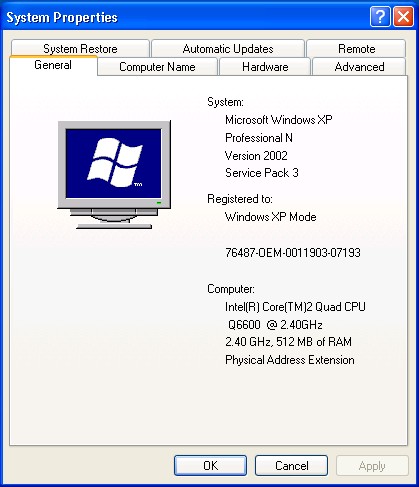 Microsoft released its initial release candidate for XP Mode last week, one day before the commencement of availability of the RTM code for Windows 7 on MSDN and TechNet. In Betanews initial tests that day, we discovered the XP Mode RC had significant trouble with installation and with establishing a working VM on the Windows 7 Release Candidate -- trouble that completely disappeared with the Windows 7 RTM code. Therefore, we recommend that you wait until receiving or purchasing the final Win7 before trying XP Mode RC or XP Mode (N) RC.
 That's not the scary part for the hundreds of millions of people who spend the bulk of the workday in Word. Beyond increasing the original $200 million in damages to $290 million, Davis also imposed a permanent injunction against sales of Microsoft Word 2003 and 2007. Assuming nothing changes from this point onward, Microsoft will no longer be able to sell Word in the US in 60 days. And if you want technical support when opening custom XML-based documents, you'll be out of luck, too, as Microsoft's help desks will be banned from answering any related questions.
 This morning, Sony announced that it intends to "take the confusion out of digital book formats" and put all its weight behind the EPUB format. By the end of 2009, Sony will only sell EPUB books in its store, and will have dropped its proprietary DRM entirely in favor of
 Though the device has been leakier than a rowboat made of Swiss cheese, Microsoft has at last given the final word on the Zune HD's availability, and It's up for pre-order today.