


By Jacqueline Emigh, Betanews
The small subset of software 'app stores' most likely to survive includes Apple's download site, Google's Android Store, and RIM's new BlackBerry App World, according to recent analysis during a webcast featuring Andy Castonguay, Yankee Group's research director.
But outside of downloadable apps, other big differentiators in the increasingly crowded broadband gadget space will include size of the device, connectivity, keyboard, screen, and user interface.
Software apps and slick phone features will help sell 3G/4G services for US mobile carriers, which are counting on text messaging charges as a "cash cow," according to the analyst.
Where Sprint has lagged behind AT&T, Verizon Wireless, and T-Mobile on the whole, the underdog is starting to catch up now, first with the Instinct phone and soon with the Palm Pre, noted Berge Ayvazian, chief strategy officer for Yankee. Sprint's 3G connectivity is also "tremendous" in comparison to competitors, contended Castonguay, who claimed the ability to travel by train from New York to Boston while scarcely dropping a call all the while.
Due to the smoothness of Palm's Linux OS and the phone's easy navigability and search functionality, the Pre will supply an even "crisper experience" than Apple's 3G iPhone, the analyst predicted. For its first two quarters of availability, the Pre will be sold exclusively through Sprint.
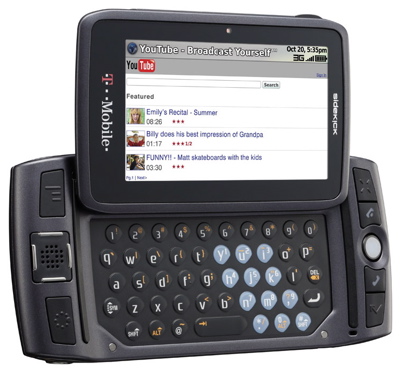
T-Mobile's Android-based, HTC-made G1 has "sold tremendously," and the G2 -- a "thinner device" with more connectivity -- is slated for launch during the third week in May.
Meanwhile, RIM's BlackBerry Storm, sold only by Verizon Wireless, is pulling "new customers [into] the RIM space," he said. Conversely, the BlackBerry Bold, available strictly through AT&T, is conveying old-time BlackBerry fans into the 3G era.
Nokia's 3G-enabled N97 will be sold by US carriers, too, and new, non-subsidized unlocked versions will be offered for around $600 in forthcoming Nokia stores, he forecast.
At the same time, although Apple hasn't said so yet, third-party partners are pointing to a June launch for an "iPhone 4G," a video-capable gizmo with a 3.2 megapixel cmaera, 32 GB capability, removable battery, standard headphone jack, and a lot of other new niceties, envisioned as standing 4.5 inches tall and weighing in at 4.4 ounces.
A June rollout of the 4G would coincide with the "Worldwide Developer Conference, iPhone 3.0 software, and expiration of AT&T [iPhone 3G] service contracts," according to the two Yankee analysts.
But as Yankee sees it, the name "iPhone 4G" is actually a "bit of a misnomer" -- since to qualify as a 4G device, a gadget needs a 100 Mbps downlink speed, a level the Group believes the future Apple device won't meet.
Also during their talk, however, Ayvazian and Castonguay mentioned the 4G devices now under way from some 80 manufacturers for Clearwire's broadband network, once the deployment moves past Portland, Oregon.
These devices include USB dongle modems from Motorola and some seven other manufacturers; Intel Echo Peak embedded WiMAX modules; Clear Spot Personal Wi-Fi Hotspots; desktop modems; the Samsung Mondi mobile Internet device (MID); and WiMAX-ready netbooks from Acer, Asus, Dell, Fujitsu, Lenovo, Panasonic, Samsung, and Toshiba.
Mobile carriers are now finding that it's actually cost-effective to subsidize netbooks, Castonguay maintained, citing that AT&T already subsidizes netbooks from Acer, LG, and Dell.
But he also hinted that Samsung's Mondi might fare better than either phones or netbooks in the 4G world, due to its combination of a pocketable form factor, a 4.3-inch screen, and the ability to run real applications and documents on Windows Mobile 6.1.
Also in terms of software, although mobile 3G and 4G phones might only get a lot of use out of three or four software applications each, their users might easily download ten times as many or more, Ayvazian suggested. "If they're $1 or they're free, it's really no sweat," Castonguay agreed.
But just posting the apps in an online store won't guarantee success, the webcast viewers were told. "Many of the announced initiatives will fail," according to the analyst. "What makes a successful app store platform? A large base of devices, a vast developer community, [and] similar device specifications."
On the business side, the list of leading mobile device platforms is somewhat different, Ayvazian observed. While Apple is gaining ground, CIOs are looking keenly at Windows Mobile, RIM, and the "robust" Nokia environment, he elaborated.
Copyright Betanews, Inc. 2009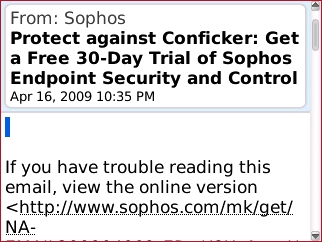 Okay, so the font file itself is still in the system, but you won't actually use it or want it. The old system fonts looked like something spat out of a Centronics dot-matrix printer, circa 1978. I remember selling dot-matrix printers in the early days, including one of the first to offer a switch that converted you from "sans-serif" to "serif," or in that particular case, from "legible" to "illegible." Until today, we 8800 users had something called "BBClarity" (which at least meant, devoid of junk) and "BBMilbank," which looked like it belonged on one of those programmable highway warning signs, shouting, "BEWARE OF ZOMBIES."
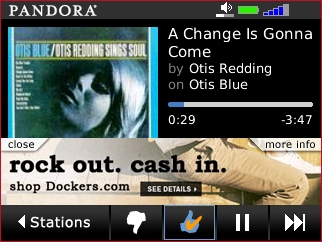 One of those apps is the mobile edition of Pandora, the original programmable radio stream that learns your musical tastes as you listen. Having Pandora in my pocket is reason alone to own a mobile handset; my friend Angela
 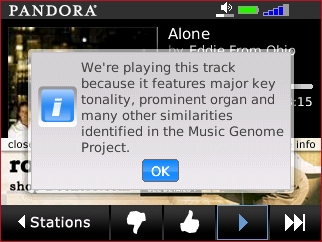 The Mobile Pandora isn't as conversational as the PC edition -- for instance, you can't go into your profile and load up all your bookmarks. You can get an explanation why you're hearing the song you're hearing, and this little feature alone shows you why the System upgrade was necessary -- on the old system, there's no way this information would be the least bit legible in a single alert box.
 The upgrade process will back up your existing calendar, e-mail, media, and personal applications automatically, and will restore them after the new modules are loaded in and verified. The verification process, for some reason, is the longest stage -- be prepared to wait as long as 45 minutes. The process in its entirety could take an hour, maybe a little longer.
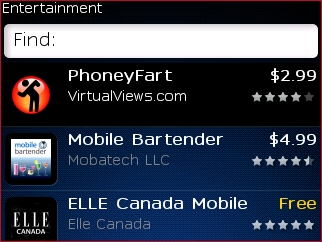
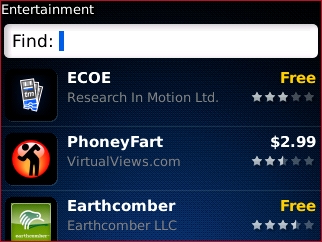 You'll notice some differences right away, some thanks to the new system, others on account of smart users who truly appreciate the low value of farting apps. The catalog is much more pleasant to read, even if -- sadly -- some of the entries haven't changed all that much since App World's premiere earlier this month. The "before" and "after" pictures above tell the story. ("ECOE" isn't very self-explanatory, is it? It's a Ticketmaster application, so you'd think it would have been named something like "Ticketmaster Application.")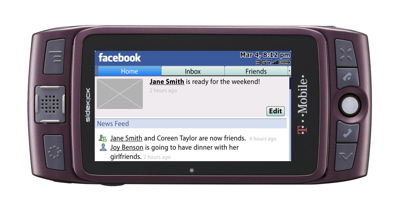

 Whether it's a new investment tack or simply goodwill to the technology community in a down economy, early-stage venture capital firm